AI Video Editor

AI Video Editor — hands-on reviews, top picks, pricing, pros and cons and a practical how-to guide on Aizhi.

  • INDIAai

    INDIAai

    INDIAai is a web portal launched by the Government of India on 07 March 2024 for artificial intelligence-related developments in India. It is known as the National AI Portal of India, which was jointly started by the Ministry of Electronics and Information Technology (MeitY), the National e-Governance Division (NeGD) and the National Association of Software and Service Companies (NASSCOM) with support from the Department of School Education and Literacy (DoSE&L) and Ministry of Human Resource Development. == History == The portal was launched on 30 May 2020, by Ravi Shankar Prasad, the Union Minister for Electronics and IT, Law and Justice and Communications, on the first anniversary of the second tenure of Prime Minister Narendra Modi-led government. A national program for the youth, 'Responsible AI for Youth', was also launched on the same day. As of 2022, the website was visited by more than 4.5 lakh users with 1.2 million page views. It has 1151 articles on artificial intelligence, 701 news stories, 98 reports, 95 case studies and 213 videos on its portal. It maintains a database on AI ecosystem of India featuring 121 government initiatives and 281 startups. In May 2022, INDIAai released a book titled 'AI for Everyone' that covers the basics of AI. Cabinet chaired by the Prime Minister Narendra Modi has approved the comprehensive national-level IndiaAI mission with a budget outlay of Rs.10,371.92 crore. The Mission will be implemented by ‘IndiaAI’ Independent Business Division (IBD) under Digital India Corporation (DIC). == Objective and features == It aims to function as a one-stop portal for all AI-related development in India. The platform publishes resources such as articles, news, interviews, and investment funding news and events for AI startups, AI companies, and educational firms related to artificial intelligence in India. It also distributes documents, case studies, and research reports. Additionally, the platform provides education and employment opportunities related to AI. It offers AI courses, both free and paid.

    Read more →
  • Preferential entailment

    Preferential entailment

    Preferential entailment is a non-monotonic logic based on selecting only models that are considered the most plausible. The plausibility of models is expressed by an ordering among models called a preference relation, hence the name preference entailment. Formally, given a propositional formula F {\displaystyle F} and an ordering over propositional models ≤ {\displaystyle \leq } , preferential entailment selects only the models of F {\displaystyle F} that are minimal according to ≤ {\displaystyle \leq } . This selection leads to a non-monotonic inference relation: F ⊨ pref G {\displaystyle F\models _{\text{pref}}G} holds if and only if all minimal models of F {\displaystyle F} according to ≤ {\displaystyle \leq } are also models of G {\displaystyle G} . Circumscription can be seen as the particular case of preferential entailment when the ordering is based on containment of the sets of variables assigned to true (in the propositional case) or containment of the extensions of predicates (in the first-order logic case).

    Read more →
  • REEM

    REEM

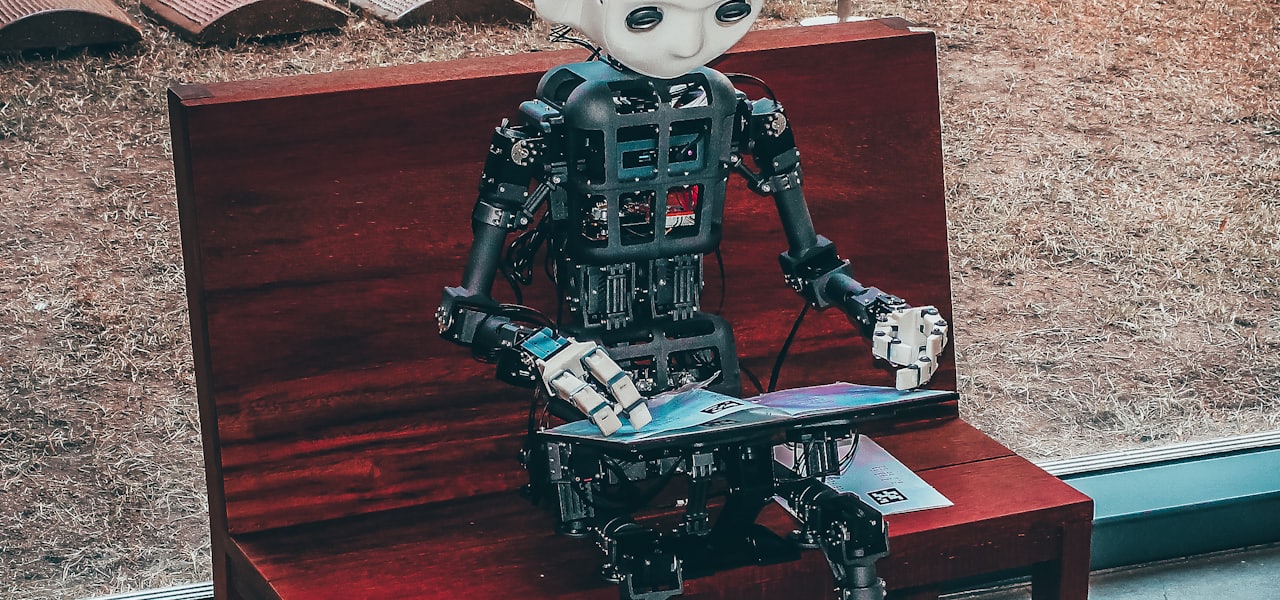
    REEM is a prototype humanoid robot built by PAL Robotics in Spain. It is a 1.70 m high humanoid robot with 22 degrees of freedom, with a mobile base with wheels, allowing it to move at 4 km/hour. The upper part of the robot consists of a torso with a touch screen, two motorized arms, which give it a high degree of expression, and a head, which is also motorized. REEM-A and REEM-B are the first and second prototypes of humanoid robots created by PAL Robotics. REEM-B can recognize, grasp and lift objects and walk by itself, avoiding obstacles through simultaneous localization and mapping. The robot accepts voice commands and can recognize faces. == Specifications ==

    Read more →
  • Google Brain

    Google Brain

    Google Brain was a deep learning artificial intelligence research team that served as the sole AI branch of Google before being incorporated under the newer umbrella of Google AI, a research division at Google dedicated to artificial intelligence. Formed in 2011, it combined open-ended machine learning research with information systems and large-scale computing resources. It created tools such as TensorFlow, which allow neural networks to be used by the public, and multiple internal AI research projects, and aimed to create research opportunities in machine learning and natural language processing. It was merged into former Google sister company DeepMind to form Google DeepMind in April 2023. == History == The Google Brain project began in 2011 as a part-time research collaboration between Google fellow Jeff Dean and Google Researcher Greg Corrado. Google Brain started as a Google X project and became so successful that it was graduated back to Google: Astro Teller has said that Google Brain paid for the entire cost of Google X. In June 2012, The New York Times reported that a cluster of 16,000 processors in 1,000 computers dedicated to mimicking some aspects of human brain activity had successfully trained itself to recognize a cat based on 10 million digital images taken from YouTube videos. The story was also covered by National Public Radio (NPR). In March 2013, Google hired Geoffrey Hinton, a leading researcher in the deep learning field, and acquired the company DNNResearch Inc. headed by Hinton. Hinton said that he would be dividing his future time between his university research and his work at Google. In April 2023, Google Brain merged with Google sister company DeepMind to form Google DeepMind, as part of the company's continued efforts to accelerate work on AI. == Team and location == Google Brain was initially established by Google Fellow Jeff Dean and visiting Stanford professor Andrew Ng. In 2014, the team included Jeff Dean, Quoc V. Le, Ilya Sutskever, Alex Krizhevsky, Samy Bengio, and Vincent Vanhoucke. In 2017, team members included Anelia Angelova, Samy Bengio, Greg Corrado, George Dahl, Michael Isard, Anjuli Kannan, Hugo Larochelle, Chris Olah, Benoit Steiner, Vincent Vanhoucke, Vijay Vasudevan, and Fernanda Viegas. Chris Lattner, who created Apple's programming language Swift and then ran Tesla's autonomy team for six months, joined Google Brain's team in August 2017. Lattner left the team in January 2020 and joined SiFive. As of 2021, Google Brain was led by Jeff Dean, Geoffrey Hinton, and Zoubin Ghahramani. Other members include Katherine Heller, Pi-Chuan Chang, Ian Simon, Jean-Philippe Vert, Nevena Lazic, Anelia Angelova, Lukasz Kaiser, Carrie Jun Cai, Eric Breck, Ruoming Pang, Carlos Riquelme, Hugo Larochelle, and David Ha. Samy Bengio left the team in April 2021, and Zoubin Ghahramani took on his responsibilities. Google Research includes Google Brain and is based in Mountain View. It also has satellite groups in Accra, Amsterdam, Atlanta, Beijing, Berlin, Cambridge, Israel, Los Angeles, London, Montreal, Munich, New York City, Paris, Pittsburgh, Princeton, San Francisco, Seattle, Tokyo, Toronto, and Zurich. == Projects == === Artificial-intelligence-devised encryption system === In October 2016, Google Brain designed an experiment to determine that neural networks are capable of learning secure symmetric encryption. In this experiment, three neural networks were created: Alice, Bob and Eve. Adhering to the idea of a generative adversarial network (GAN), the goal of the experiment was for Alice to send an encrypted message to Bob that Bob could decrypt, but the adversary, Eve, could not. Alice and Bob maintained an advantage over Eve, in that they shared a key used for encryption and decryption. In doing so, Google Brain demonstrated the capability of neural networks to learn secure encryption. === Image enhancement === In February 2017, Google Brain determined a probabilistic method for converting pictures with 8x8 resolution to a resolution of 32x32. The method built upon an already existing probabilistic model called pixelCNN to generate pixel translations. The proposed software utilizes two neural networks to make approximations for the pixel makeup of translated images. The first network, known as the "conditioning network," downsizes high-resolution images to 8x8 and attempts to create mappings from the original 8x8 image to these higher-resolution ones. The other network, known as the "prior network," uses the mappings from the previous network to add more detail to the original image. The resulting translated image is not the same image in higher resolution, but rather a 32x32 resolution estimation based on other existing high-resolution images. Google Brain's results indicate the possibility for neural networks to enhance images. === Google Translate === The Google Brain contributed to the Google Translate project by employing a new deep learning system that combines artificial neural networks with vast databases of multilingual texts. In September 2016, Google Neural Machine Translation (GNMT) was launched, an end-to-end learning framework, able to learn from a large number of examples. Previously, Google Translate's Phrase-Based Machine Translation (PBMT) approach would statistically analyze word by word and try to match corresponding words in other languages without considering the surrounding phrases in the sentence. But rather than choosing a replacement for each individual word in the desired language, GNMT evaluates word segments in the context of the rest of the sentence to choose more accurate replacements. Compared to older PBMT models, the GNMT model scored a 24% improvement in similarity to human translation, with a 60% reduction in errors. The GNMT has also shown significant improvement for notoriously difficult translations, like Chinese to English. While the introduction of the GNMT has increased the quality of Google Translate's translations for the pilot languages, it was very difficult to create such improvements for all of its 103 languages. Addressing this problem, the Google Brain Team was able to develop a Multilingual GNMT system, which extended the previous one by enabling translations between multiple languages. Furthermore, it allows for Zero-Shot Translations, which are translations between two languages that the system has never explicitly seen before. Google announced that Google Translate can now also translate without transcribing, using neural networks. This means that it is possible to translate speech in one language directly into text in another language, without first transcribing it to text. According to the Researchers at Google Brain, this intermediate step can be avoided using neural networks. In order for the system to learn this, they exposed it to many hours of Spanish audio together with the corresponding English text. The different layers of neural networks, replicating the human brain, were able to link the corresponding parts and subsequently manipulate the audio waveform until it was transformed to English text. Another drawback of the GNMT model is that it causes the time of translation to increase exponentially with the number of words in the sentence. This caused the Google Brain Team to add 2000 more processors to ensure the new translation process would still be fast and reliable. === Robotics === Aiming to improve traditional robotics control algorithms where new skills of a robot need to be hand-programmed, robotics researchers at Google Brain are developing machine learning techniques to allow robots to learn new skills on their own. They also attempt to develop ways for information sharing between robots so that robots can learn from each other during their learning process, also known as cloud robotics. As a result, Google has launched the Google Cloud Robotics Platform for developers in 2019, an effort to combine robotics, AI, and the cloud to enable efficient robotic automation through cloud-connected collaborative robots. Robotics research at Google Brain has focused mostly on improving and applying deep learning algorithms to enable robots to complete tasks by learning from experience, simulation, human demonstrations, and/or visual representations. For example, Google Brain researchers showed that robots can learn to pick and throw rigid objects into selected boxes by experimenting in an environment without being pre-programmed to do so. In another research, researchers trained robots to learn behaviors such as pouring liquid from a cup; robots learned from videos of human demonstrations recorded from multiple viewpoints. Google Brain researchers have collaborated with other companies and academic institutions on robotics research. In 2016, the Google Brain Team collaborated with researchers at X in a research on learning hand-eye coordination for robotic grasping. Their method allowed real-time robot control for grasping novel objec

    Read more →
  • Random feature

    Random feature

    Random features (RF) are a technique used in machine learning to approximate kernel methods, introduced by Ali Rahimi and Ben Recht in their 2007 paper "Random Features for Large-Scale Kernel Machines", and extended by. RF uses a Monte Carlo approximation to kernel functions by randomly sampled feature maps. It is used for datasets that are too large for traditional kernel methods like support vector machine, kernel ridge regression, and gaussian process. == Mathematics == === Kernel method === Given a feature map ϕ : R d → V {\textstyle \phi :\mathbb {R} ^{d}\to V} , where V {\textstyle V} is a Hilbert space (more specifically, a reproducing kernel Hilbert space), the kernel trick replaces inner products in feature space ⟨ ϕ ( x i ) , ϕ ( x j ) ⟩ V {\displaystyle \langle \phi (x_{i}),\phi (x_{j})\rangle _{V}} by a kernel function k ( x i , x j ) : R d × R d → R {\displaystyle k(x_{i},x_{j}):\mathbb {R} ^{d}\times \mathbb {R} ^{d}\to \mathbb {R} } Kernel methods replaces linear operations in high-dimensional space by operations on the kernel matrix: K X := [ k ( x i , x j ) ] i , j ∈ 1 : N {\displaystyle K_{X}:=[k(x_{i},x_{j})]_{i,j\in 1:N}} where N {\textstyle N} is the number of data points. === Random kernel method === The problem with kernel methods is that the kernel matrix K X {\textstyle K_{X}} has size N × N {\textstyle N\times N} . This becomes computationally infeasible when N {\textstyle N} reaches the order of a million. The random kernel method replaces the kernel function k {\textstyle k} by an inner product in low-dimensional feature space R D {\textstyle \mathbb {R} ^{D}} : k ( x , y ) ≈ ⟨ z ( x ) , z ( y ) ⟩ {\displaystyle k(x,y)\approx \langle z(x),z(y)\rangle } where z {\textstyle z} is a randomly sampled feature map z : R d → R D {\textstyle z:\mathbb {R} ^{d}\to \mathbb {R} ^{D}} . This converts kernel linear regression into linear regression in feature space, kernel SVM into SVM in feature space, etc. Since we have K X ≈ Z X T Z X {\displaystyle K_{X}\approx Z_{X}^{T}Z_{X}} where Z X = [ z ( x 1 ) , … , z ( x N ) ] {\displaystyle Z_{X}=[z(x_{1}),\dots ,z(x_{N})]} , these methods no longer involve matrices of size O ( N 2 ) {\textstyle O(N^{2})} , but only random feature matrices of size O ( D N ) {\textstyle O(DN)} . == Random Fourier feature == === Radial basis function kernel === The radial basis function (RBF) kernel on two samples x i , x j ∈ R d {\displaystyle x_{i},x_{j}\in \mathbb {R} ^{d}} is defined as k ( x i , x j ) = exp ⁡ ( − ‖ x i − x j ‖ 2 2 σ 2 ) {\displaystyle k(x_{i},x_{j})=\exp \left(-{\frac {\|x_{i}-x_{j}\|^{2}}{2\sigma ^{2}}}\right)} where ‖ x i − x j ‖ 2 {\displaystyle \|x_{i}-x_{j}\|^{2}} is the squared Euclidean distance and σ {\displaystyle \sigma } is a free parameter defining the shape of the kernel. It can be approximated by a random Fourier feature map z : R d → R 2 D {\displaystyle z:\mathbb {R} ^{d}\to \mathbb {R} ^{2D}} : z ( x ) := 1 D [ cos ⁡ ⟨ ω 1 , x ⟩ , sin ⁡ ⟨ ω 1 , x ⟩ , … , cos ⁡ ⟨ ω D , x ⟩ , sin ⁡ ⟨ ω D , x ⟩ ] T {\displaystyle z(x):={\frac {1}{\sqrt {D}}}[\cos \langle \omega _{1},x\rangle ,\sin \langle \omega _{1},x\rangle ,\ldots ,\cos \langle \omega _{D},x\rangle ,\sin \langle \omega _{D},x\rangle ]^{T}} where ω 1 , . . . , ω D {\displaystyle \omega _{1},...,\omega _{D}} are IID samples from the multidimensional normal distribution N ( 0 , σ − 2 I ) {\displaystyle N(0,\sigma ^{-2}I)} . Since cos , sin {\displaystyle \cos ,\sin } are bounded, there is a stronger convergence guarantee by Hoeffding's inequality. === Random Fourier features === By Bochner's theorem, the above construction can be generalized to arbitrary positive definite shift-invariant kernel k ( x , y ) = k ( x − y ) {\displaystyle k(x,y)=k(x-y)} . Define its Fourier transform p ( ω ) = 1 2 π ∫ R d e − j ⟨ ω , Δ ⟩ k ( Δ ) d Δ {\displaystyle p(\omega )={\frac {1}{2\pi }}\int _{\mathbb {R} ^{d}}e^{-j\langle \omega ,\Delta \rangle }k(\Delta )d\Delta } then ω 1 , . . . , ω D {\displaystyle \omega _{1},...,\omega _{D}} are sampled IID from the probability distribution with probability density p {\displaystyle p} . This applies for other kernels like the Laplace kernel and the Cauchy kernel. === Neural network interpretation === Given a random Fourier feature map z {\displaystyle z} , training the feature on a dataset by featurized linear regression is equivalent to fitting complex parameters θ 1 , … , θ D ∈ C {\displaystyle \theta _{1},\dots ,\theta _{D}\in \mathbb {C} } such that f θ ( x ) = R e ( ∑ k θ k e i ⟨ ω k , x ⟩ ) {\displaystyle f_{\theta }(x)=\mathrm {Re} \left(\sum _{k}\theta _{k}e^{i\langle \omega _{k},x\rangle }\right)} which is a neural network with a single hidden layer, with activation function t ↦ e i t {\displaystyle t\mapsto e^{it}} , zero bias, and the parameters in the first layer frozen. In the overparameterized case, when 2 D ≥ N {\displaystyle 2D\geq N} , the network linearly interpolates the dataset { ( x i , y i ) } i ∈ 1 : N {\displaystyle \{(x_{i},y_{i})\}_{i\in 1:N}} , and the network parameters is the least-norm solution: θ ^ = arg ⁡ min θ ∈ C D , f θ ( x k ) = y k ∀ k ∈ 1 : N ‖ θ ‖ {\displaystyle {\hat {\theta }}=\arg \min _{\theta \in \mathbb {C} ^{D},f_{\theta }(x_{k})=y_{k}\forall k\in 1:N}\|\theta \|} At the limit of D → ∞ {\displaystyle D\to \infty } , the L2 norm ‖ θ ^ ‖ → ‖ f K ‖ H {\displaystyle \|{\hat {\theta }}\|\to \|f_{K}\|_{H}} where f K {\displaystyle f_{K}} is the interpolating function obtained by the kernel regression with the original kernel, and ‖ ⋅ ‖ H {\displaystyle \|\cdot \|_{H}} is the norm in the reproducing kernel Hilbert space for the kernel. == Other examples == === Random binning features === A random binning features map partitions the input space using randomly shifted grids at randomly chosen resolutions and assigns to an input point a binary bit string that corresponds to the bins in which it falls. The grids are constructed so that the probability that two points x i , x j ∈ R d {\displaystyle x_{i},x_{j}\in \mathbb {R} ^{d}} are assigned to the same bin is proportional to K ( x i , x j ) {\displaystyle K(x_{i},x_{j})} . The inner product between a pair of transformed points is proportional to the number of times the two points are binned together, and is therefore an unbiased estimate of K ( x i , x j ) {\displaystyle K(x_{i},x_{j})} . Since this mapping is not smooth and uses the proximity between input points, Random Binning Features works well for approximating kernels that depend only on the L 1 {\displaystyle L_{1}} distance between datapoints. === Orthogonal random features === Orthogonal random features uses a random orthogonal matrix instead of a random Fourier matrix. == Historical context == In NIPS 2006, deep learning had just become competitive with linear models like PCA and linear SVMs for large datasets, and people speculated about whether it could compete with kernel SVMs. However, there was no way to train kernel SVM on large datasets. The two authors developed the random feature method to train those. It was then found that the O ( 1 / D ) {\displaystyle O(1/D)} variance bound did not match practice: the variance bound predicts that approximation to within 0.01 {\displaystyle 0.01} requires D ∼ 10 4 {\displaystyle D\sim 10^{4}} , but in practice required only ∼ 10 2 {\displaystyle \sim 10^{2}} . Attempting to discover what caused this led to the subsequent two papers.

    Read more →
  • TensorFlow

    TensorFlow

    TensorFlow is a software library for machine learning and artificial intelligence. It can be used across a range of tasks, but is used mainly for training and inference of neural networks. It is one of the most popular deep learning frameworks, alongside others such as PyTorch. It is free and open-source software released under the Apache License 2.0. It was developed by the Google Brain team for Google's internal use in research and production. The initial version was released under the Apache License 2.0 in 2015. Google released an updated version, TensorFlow 2.0, in September 2019. TensorFlow can be used in a wide variety of programming languages, including Python, JavaScript, C++, and Java, facilitating its use in a range of applications in many sectors. == History == === DistBelief === Starting in 2011, Google Brain built DistBelief as a proprietary machine learning system based on deep learning neural networks. Its use grew rapidly across diverse Alphabet companies in both research and commercial applications. Google assigned multiple computer scientists, including Jeff Dean, to simplify and refactor the codebase of DistBelief into a faster, more robust application-grade library, which became TensorFlow. In 2009, the team, led by Geoffrey Hinton, had implemented generalized backpropagation and other improvements, which allowed generation of neural networks with substantially higher accuracy, for instance a 25% reduction in errors in speech recognition. === TensorFlow === TensorFlow is Google Brain's second-generation system. Version 1.0.0 was released on February 11, 2017. While the reference implementation runs on single devices, TensorFlow can run on multiple CPUs and GPUs (with optional CUDA and SYCL extensions for general-purpose computing on graphics processing units). TensorFlow is available on 64-bit Linux, macOS, Windows, and mobile computing platforms including Android and iOS. Its flexible architecture allows for easy deployment of computation across a variety of platforms (CPUs, GPUs, TPUs), and from desktops to clusters of servers to mobile and edge devices. TensorFlow computations are expressed as stateful dataflow graphs. The name TensorFlow derives from the operations that such neural networks perform on multidimensional data arrays, which are referred to as tensors. During the Google I/O Conference in June 2016, Jeff Dean stated that 1,500 repositories on GitHub mentioned TensorFlow, of which only 5 were from Google. In March 2018, Google announced TensorFlow.js version 1.0 for machine learning in JavaScript. In Jan 2019, Google announced TensorFlow 2.0. It became officially available in September 2019. In May 2019, Google announced TensorFlow Graphics for deep learning in computer graphics. === Tensor processing unit (TPU) === In May 2016, Google announced its Tensor processing unit (TPU), an application-specific integrated circuit (ASIC, a hardware chip) built specifically for machine learning and tailored for TensorFlow. A TPU is a programmable AI accelerator designed to provide high throughput of low-precision arithmetic (e.g., 8-bit), and oriented toward using or running models rather than training them. Google announced they had been running TPUs inside their data centers for more than a year, and had found them to deliver an order of magnitude better-optimized performance per watt for machine learning. In May 2017, Google announced the second-generation, as well as the availability of the TPUs in Google Compute Engine. The second-generation TPUs deliver up to 180 teraflops of performance, and when organized into clusters of 64 TPUs, provide up to 11.5 petaflops. In May 2018, Google announced the third-generation TPUs delivering up to 420 teraflops of performance and 128 GB high bandwidth memory (HBM). Cloud TPU v3 Pods offer 100+ petaflops of performance and 32 TB HBM. In February 2018, Google announced that they were making TPUs available in beta on the Google Cloud Platform. === Edge TPU === In July 2018, the Edge TPU was announced. Edge TPU is Google's purpose-built ASIC chip designed to run TensorFlow Lite machine learning (ML) models on small client computing devices such as smartphones known as edge computing. === TensorFlow Lite === In May 2017, Google announced TensorFlow Lite as a software stack to support machine learning models for mobile and embedded devices, and in November 2017, provided the developer preview. In January 2019, the TensorFlow team released a developer preview of the mobile GPU inference engine with OpenGL ES 3.1 Compute Shaders on Android devices and Metal Compute Shaders on iOS devices. In May 2019, Google announced that their TensorFlow Lite Micro (also known as TensorFlow Lite for Microcontrollers) and ARM's uTensor would be merging. It was renamed as LiteRT in 2024. === TensorFlow 2.0 === As TensorFlow's market share among research papers was declining to the advantage of PyTorch, the TensorFlow Team announced a release of a new major version of the library in September 2019. TensorFlow 2.0 introduced many changes, the most significant being TensorFlow eager, which changed the automatic differentiation scheme from the static computational graph to the "Define-by-Run" scheme originally made popular by Chainer and later PyTorch. Other major changes included removal of old libraries, cross-compatibility between trained models on different versions of TensorFlow, and significant improvements to the performance on GPU. == Features == === AutoDifferentiation === AutoDifferentiation is the process of automatically calculating the gradient vector of a model with respect to each of its parameters. With this feature, TensorFlow can automatically compute the gradients for the parameters in a model, which is useful to algorithms such as backpropagation which require gradients to optimize performance. To do so, the framework must keep track of the order of operations done to the input Tensors in a model, and then compute the gradients with respect to the appropriate parameters. === Eager execution === TensorFlow includes an "eager execution" mode, which means that operations are evaluated immediately as opposed to being added to a computational graph which is executed later. Code executed eagerly can be examined step-by step-through a debugger, since data is augmented at each line of code rather than later in a computational graph. This execution paradigm is considered to be easier to debug because of its step by step transparency. === Distribute === In both eager and graph executions, TensorFlow provides an API for distributing computation across multiple devices with various distribution strategies. This distributed computing can often speed up the execution of training and evaluating of TensorFlow models and is a common practice in the field of AI. === Losses === To train and assess models, TensorFlow provides a set of loss functions (also known as cost functions). Some popular examples include mean squared error (MSE) and binary cross entropy (BCE). === Metrics === In order to assess the performance of machine learning models, TensorFlow gives API access to commonly used metrics. Examples include various accuracy metrics (binary, categorical, sparse categorical) along with other metrics such as Precision, Recall, and Intersection-over-Union (IoU). === TF.nn === TensorFlow.nn is a module for executing primitive neural network operations on models. Some of these operations include variations of convolutions (1/2/3D, Atrous, depthwise), activation functions (Softmax, RELU, GELU, Sigmoid, etc.) and their variations, and other operations (max-pooling, bias-add, etc.). === Optimizers === TensorFlow offers a set of optimizers for training neural networks, including ADAM, ADAGRAD, and Stochastic Gradient Descent (SGD). When training a model, different optimizers offer different modes of parameter tuning, often affecting a model's convergence and performance. == Usage and extensions == === TensorFlow === TensorFlow serves as a core platform and library for machine learning. TensorFlow's APIs use Keras to allow users to make their own machine-learning models. In addition to building and training their model, TensorFlow can also help load the data to train the model, and deploy it using TensorFlow Serving. TensorFlow provides a stable Python Application Program Interface (API), as well as APIs without backwards compatibility guarantee for JavaScript, C++, and Java. Third-party language binding packages are also available for C#, Haskell, Julia, MATLAB, Object Pascal, R, Scala, Rust, OCaml, and Crystal. Bindings that are now archived and unsupported include Go and Swift. === TensorFlow.js === TensorFlow also has a library for machine learning in JavaScript. Using the provided JavaScript APIs, TensorFlow.js allows users to use either Tensorflow.js models or converted models from TensorFlow or TFLite, retrain the given models, and run on the web. === LiteRT === LiteRT, formerly known as Te

    Read more →
  • Global call for AI red lines

    Global call for AI red lines

    The global call for AI red lines is a declaration made on 22 September 2025 calling on governments to define and internationally prohibit unacceptable AI uses and behaviors. The online declaration was announced by Nobel Peace Prize laureate Maria Ressa at the 80th United Nations General Assembly high-level week. The declaration was initially signed by 200 prominent politicians and scientists, including 10 Nobel Prize winners. The call does not specify which red lines to set, but suggests several, such as banning bioweapon design, mass surveillance or AI impersonation. == The declaration == The declaration was published online as an open letter on 22 September 2025. Nobel Peace Prize laureate Maria Ressa announced it in her opening speech at the 80th United Nations General Assembly high-level week in New York, urging governments to "define what AI should never be allowed to do" and "establish clear international boundaries to prevent universally unacceptable risks for A.I." The initiative was organized by three nonprofit organisations: the French Center for AI Safety (CeSIA), The Future Society, and the Center for Human-Compatible Artificial Intelligence (CHAI). The letter argues that humanity faces risks such as engineered pandemics, widespread disinformation, large-scale manipulation, unemployment and loss of control. Proponents argue that national laws are insufficient to address these risks and that "an international agreement on clear and verifiable red lines is necessary". They urge governments to reach an agreement by the end of 2026, and called for robust enforcement mechanisms and the creation of an independent organisation to implement it. The letter does not call for specific red lines, but suggests the possibility of banning lethal autonomous weapons, autonomous replication of AI systems and the use of AI in nuclear warfare. Other examples of possible red lines include social scoring, mass surveillance, bioweapon design, AI-generated child sexual abuse material and AI impersonation. A red line could prohibit either AI behaviors (what AI systems should be guaranteed to never do even if asked to) or AI uses. == Signatories == When published, the online declaration was signed by more than 200 prominent politicians and scientists, including 10 Nobel Prize winners. Signers include former president of Colombia Juan Manuel Santos and researchers Geoffrey Hinton and Yoshua Bengio. It also includes popular authors like Stephen Fry and Yuval Noah Harari. The letter received support from European lawmakers, including former Italian prime minister Enrico Letta, and former president of Ireland Mary Robinson. == Development of red lines == As of 2025, there is no global red line on AI. Some regional red lines exist, such as with the uses deemed "unacceptable" by the AI Act in Europe, and with the US-China agreement not to leave to AI the decision of whether to launch nuclear weapons. At the United Nations Security Council, days after the declaration, Michael Kratsios, Donald Trump's director of the White House Office of Science and Technology Policy, said "We totally reject all efforts by international bodies to assert centralized control and global governance of AI." The topic of AI red lines gained prominence in 2026 with the dispute between Anthropic and the Department of Defense (DoD), which resulted from the DoD requesting Anthropic to remove contractual red lines on fully autonomous weapons and mass domestic surveillance. The event led employees from Google and OpenAI as well as Senate Democrats to further call for red lines on military use of AI. Senator Adam Schiff proposed a bill to "codify" Anthropic's red lines.

    Read more →
  • GPT-5.3-Codex

    GPT-5.3-Codex

    GPT-5.3-Codex (Generative Pre-trained Transformer 5.3 Codex) is a large language model (LLM) announced and released by OpenAI on February 5, 2026. It is made as a competitor to Claude's Opus 4.6, focusing on code generation, speed and the ability to search repositories, run terminal commands and at the same time, debug code. In technical benchmarks, it is reported that GPT-5.3 Codex is 25% faster than Opus 4.6. GPT-5.3 Codex is available in the Codex app and on the web; access via API is also planned. According to OpenAI, GPT-5.3-Codex is the company's "first model that was instrumental in creating itself." On February 12, 2026, GPT-5.3-Codex-Spark was released in a research preview, which is a smaller version of GPT-5.3-Codex which supports text-only input. As of February 2026, GPT-5.3-Codex is only available for ChatGPT Pro ($200/month) subscribers.

    Read more →
  • Tabletopia

    Tabletopia

    Tabletopia is an online portal for users to play and create virtual tabletop games. The platform is developed by Tabletopia Inc and initially was released as a web browser based service after a successful crowdfunding campaign in August 2015. In December 2016 Tabletopia was released on Steam, and later in 2018 became available in AppStore and Google Play. == Gameplay == Tabletopia is a sandbox system for running any game. That means no AI or rules enforcement. Participating players will have to know how to play the game. Nevertheless, the platform has some automated actions available, like card-shuffling and dealing, dice-rolling, magnetic placement of components in special zones, hand management, and some others. Tabletopia also features ready game setups for various player numbers to facilitate gameplay. It also has customisable camera controls which let players save camera positions and switch between them using hot keys. People can use the Game Designer mode to design and create their own board games using the component library. They can then monetise the games with a 70/30 split to the game designer. == Development == Tabletopia was created in early 2014, by Tim Bokarev and his partners Artem Zinoviev and Dmitry Sergeev. These co-founders already had experience in the video and board games industry. Their other projects include Promo Interactive, an internet advertising agency, Playtox, a mobile MMORPG, Igrology, a game studio, and Tesera.ru, the main Russian-speaking board gaming portal. By Spring 2014, Artem, Dmitry and Tim created Tabletopia Inc. USA and started development. Tabletopia is a multinational crew that includes professionals from USA, Ukraine, Australia, Ireland, and Germany. The Kickstarter campaign in August 2015 earned $133,721 by 2,545 backers. Tabletopia received Green Light on Steam in September 2015 and was released on Steam in March 2016. The platform remained in Early Access until December 2016, when it was officially released on Steam and on the web. In February 2018 it was released as a stand-alone app for iOS tablets, and in September 2018 for Android tablets.

    Read more →
  • Turing's Wager

    Turing's Wager

    Turing's Wager is a philosophical argument that claims it is impossible to infer or deduce a detailed mathematical model of the human brain within a reasonable timescale, and thus impossible in any practical sense. The argument was first given in 1950 by the computational theorist Alan Turing in his paper Computing Machinery and Intelligence, published in Mind (Turing 1950, p. 453). The argument asserts that determining any mathematical model of a computer (its source code or any isomorphic equivalent such as a Turing machine or virtual simulation) is not possible in a reasonable timeframe. As a consequence, determining a mathematical model of the human brain (which is, by its nature, more complicated) must also be impossible within that timeframe. == Effect of modern technology on the wager == It has been argued that modern neuroimaging techniques will allow researchers to create accurate simulations of the human mind within the 21st century (Kurzweil 2012; Markram 2012, Fildes 2009), thereby overcoming the wager. Others have argued that such claims are unjustified (Thwaites et al. 2017). == Relationship between Turing's Wager and the Turing Test == The Turing Test attempts to define when a machine might be said to possess human intelligence, while Turing's Wager is an argument aiming to demonstrate that characterising the brain mathematically will take over a thousand years. While building an artificial intelligence and mapping the human brain are both difficult endeavours, the former is actually a sub-problem of the latter (Thwaites et al. 2017).

    Read more →
  • R2ML

    R2ML

    The REWERSE Rule Markup Language (R2ML) is developed by the REWERSE Working Group I1 for the purpose of rules interchange between different systems and tools. == Scope == An XML based rule language; Support for: integrity rules, derivation rules, production rules and reaction rules; Integrate functional languages (such as OCL) with Datalog languages (such as SWRL); Serialization and interchange of rules by specific software tools; Integrating rule reasoning with actual server side technologies; Deploying, publishing and communicating rules in a network. == Design principles == Modeled using MDA; Rule concepts defined with the help of MOF/UML; Required to accommodate: Web naming concepts, such as URIs and XML namespaces; The ontological distinction between objects and data values; The datatype concepts of RDF and user-defined datatypes; Actions (following OMG PRR submission); Events; EBNF abstract syntax; XML based concrete syntax validated by an XML Schema; Allowing different semantics for rules.

    Read more →
  • China brain

    China brain

    In the philosophy of mind, the China brain thought experiment (also known as the Chinese Nation, Chinese Gym, or China-body) considers what would happen if each person in the entire population of China were asked to simulate the action of one neuron in the brain, using telephones or walkie-talkies to simulate the axons and dendrites that connect neurons. The question this thought experiment attempts to answer is whether this arrangement would have a mind or consciousness in the same way that the human brain exhibits. Early versions of this scenario were put forward in 1961 by Anatoly Dneprov, in 1974 by Lawrence Davis, and again in 1978 by Ned Block. Block argues that the China brain would not have a mind, whereas Daniel Dennett argues that it would. The China brain problem is a special case of the more general problem of whether minds could exist within other, larger minds. The Chinese room scenario analyzed by John Searle is a similar thought experiment in philosophy of mind that relates to artificial intelligence. Instead of people who each model a single neuron of the brain, in the Chinese room, clerks who do not speak Chinese accept notes in Chinese and return an answer in Chinese according to a set of rules, without the people in the room ever understanding what those notes mean. In fact, the original short story The Game (1961) by Dneprov contains both the China brain and the Chinese room scenarios. == Background == Many theories of mental states are materialist, that is, they describe the mind as the behavior of a physical object like the brain. One formerly prominent example is the identity theory, which says that mental states are brain states. One criticism is the problem of multiple realizability. The physicalist theory that responds to this is functionalism, which states that a mental state can be whatever functions as a mental state. That is, the mind can be composed of neurons, or it could be composed of wood, rocks or toilet paper, as long as it provides mental functionality. == Description == Suppose that the whole nation of China were reordered to simulate the workings of a single brain (that is, to act as a mind according to functionalism). Each Chinese person acts as (say) a neuron, and communicates by special two-way radio in corresponding way to the other people. The current mental state of the China brain is displayed on satellites that may be seen from anywhere in China. The China brain would then be connected via radio to a body, one that provides the sensory inputs and behavioral outputs of the China brain. Thus, the China brain possesses all the elements of a functional description of mind: sensory inputs, behavioral outputs, and internal mental states causally connected to other mental states. If the nation of China can be made to act in this way, then, according to functionalism, this system would have a mind. Block's goal is to show how unintuitive it is to think that such an arrangement could create a mind capable of thoughts and feelings. == Consciousness == The China brain argues that consciousness is a problem for functionalism. Block's Chinese nation presents a version of what is known as the absent qualia objection to functionalism because it purports to show that it is possible for something to be functionally equivalent to a human being and yet have no conscious experience. A creature that functions like a human being but does not feel anything is known as a "philosophical zombie". So the absent qualia objection to functionalism could also be called the "zombie objection". == Criticisms == Some philosophers, like Daniel Dennett, have concluded that the China brain does create a mental state. Functionalist philosophers of mind endorse the idea that something like the China brain can realise a mind, and that neurons are, in principle, not the only material that can create a mental state.

    Read more →
  • Non-local means

    Non-local means

    Non-local means is an algorithm in image processing for image denoising. Unlike "local mean" filters, which take the mean value of a group of pixels surrounding a target pixel to smooth the image, non-local means filtering takes a mean of all pixels in the image, weighted by how similar these pixels are to the target pixel. This results in much greater post-filtering clarity, and less loss of detail in the image compared with local mean algorithms. If compared with other well-known denoising techniques, non-local means adds "method noise" (i.e. error in the denoising process) which looks more like white noise, which is desirable because it is typically less disturbing in the denoised product. Recently non-local means has been extended to other image processing applications such as deinterlacing, view interpolation, and depth maps regularization. == Definition == Suppose Ω {\displaystyle \Omega } is the area of an image, and p {\displaystyle p} and q {\displaystyle q} are two points within the image. Then, the algorithm is: u ( p ) = 1 C ( p ) ∫ Ω v ( q ) f ( p , q ) d q . {\displaystyle u(p)={1 \over C(p)}\int _{\Omega }v(q)f(p,q)\,\mathrm {d} q.} where u ( p ) {\displaystyle u(p)} is the filtered value of the image at point p {\displaystyle p} , v ( q ) {\displaystyle v(q)} is the unfiltered value of the image at point q {\displaystyle q} , f ( p , q ) {\displaystyle f(p,q)} is the weighting function, and the integral is evaluated ∀ q ∈ Ω {\displaystyle \forall q\in \Omega } . C ( p ) {\displaystyle C(p)} is a normalizing factor, given by C ( p ) = ∫ Ω f ( p , q ) d q . {\displaystyle C(p)=\int _{\Omega }f(p,q)\,\mathrm {d} q.} == Common weighting functions == The purpose of the weighting function, f ( p , q ) {\displaystyle f(p,q)} , is to determine how closely related the image at the point p {\displaystyle p} is to the image at the point q {\displaystyle q} . It can take many forms. === Gaussian === The Gaussian weighting function sets up a normal distribution with a mean, μ = B ( p ) {\displaystyle \mu =B(p)} and a variable standard deviation: f ( p , q ) = e − | B ( q ) − B ( p ) | 2 h 2 {\displaystyle f(p,q)=e^{-{{\left\vert B(q)-B(p)\right\vert ^{2}} \over h^{2}}}} where h {\displaystyle h} is the filtering parameter (i.e., standard deviation) and B ( p ) {\displaystyle B(p)} is the local mean value of the image point values surrounding p {\displaystyle p} . == Discrete algorithm == For an image, Ω {\displaystyle \Omega } , with discrete pixels, a discrete algorithm is required. u ( p ) = 1 C ( p ) ∑ q ∈ Ω v ( q ) f ( p , q ) {\displaystyle u(p)={1 \over C(p)}\sum _{q\in \Omega }v(q)f(p,q)} where, once again, v ( q ) {\displaystyle v(q)} is the unfiltered value of the image at point q {\displaystyle q} . C ( p ) {\displaystyle C(p)} is given by: C ( p ) = ∑ q ∈ Ω f ( p , q ) {\displaystyle C(p)=\sum _{q\in \Omega }f(p,q)} Then, for a Gaussian weighting function, f ( p , q ) = e − | B ( q ) 2 − B ( p ) 2 | h 2 {\displaystyle f(p,q)=e^{-{{\left\vert B(q)^{2}-B(p)^{2}\right\vert } \over h^{2}}}} where B ( p ) {\displaystyle B(p)} is given by: B ( p ) = 1 | R ( p ) | ∑ i ∈ R ( p ) v ( i ) {\displaystyle B(p)={1 \over |R(p)|}\sum _{i\in R(p)}v(i)} where R ( p ) ⊆ Ω {\displaystyle R(p)\subseteq \Omega } and is a square region of pixels surrounding p {\displaystyle p} and | R ( p ) | {\displaystyle |R(p)|} is the number of pixels in the region R {\displaystyle R} . == Efficient implementation == The computational complexity of the non-local means algorithm is quadratic in the number of pixels in the image, making it particularly expensive to apply directly. Several techniques were proposed to speed up execution. One simple variant consists of restricting the computation of the mean for each pixel to a search window centred on the pixel itself, instead of the whole image. Another approximation uses summed-area tables and fast Fourier transform to calculate the similarity window between two pixels, speeding up the algorithm by a factor of 50 while preserving comparable quality of the result.

    Read more →
  • Mathematical model

    Mathematical model

    A mathematical model is an abstract description of a concrete system using mathematical concepts and language. The process of developing a mathematical model is termed mathematical modeling. Mathematical models are used in many fields, including applied mathematics, natural sciences, social sciences and engineering. In particular, the field of operations research studies the use of mathematical modelling and related tools to solve problems in business or military operations. A model may help to characterize a system by studying the effects of different components, which may be used to make predictions about behavior or solve specific problems. == Elements of a mathematical model == Mathematical models can take many forms, including dynamical systems, statistical models, differential equations, or game theoretic models. These and other types of models can overlap, with a given model involving a variety of abstract structures. In many cases, the quality of a scientific field depends on how well the mathematical models developed on the theoretical side agree with results of repeatable experiments. Lack of agreement between theoretical mathematical models and experimental measurements often leads to important advances as better theories are developed. In the physical sciences, a traditional mathematical model contains most of the following elements: Governing equations Supplementary sub-models Defining equations Constitutive equations Assumptions and constraints Initial and boundary conditions Classical constraints and kinematic equations == Classifications == Mathematical models are of different types: === Linear vs. nonlinear === If all the operators in a mathematical model exhibit linearity, the resulting mathematical model is defined as linear. All other models are considered nonlinear. The definition of linearity and nonlinearity is dependent on context, and linear models may have nonlinear expressions in them. For example, in a statistical linear model, it is assumed that a relationship is linear in the parameters, but it may be nonlinear in the predictor variables. Similarly, a differential equation is said to be linear if it can be written with linear differential operators, but it can still have nonlinear expressions in it. In a mathematical programming model, if the objective functions and constraints are represented entirely by linear equations, then the model is regarded as a linear model. If one or more of the objective functions or constraints are represented with a nonlinear equation, then the model is known as a nonlinear model. Linear structure implies that a problem can be decomposed into simpler parts that can be treated independently or analyzed at a different scale, and therefore that the results will remain valid if the initial is recomposed or rescaled. Nonlinearity, even in fairly simple systems, is often associated with phenomena such as chaos and irreversibility. Although there are exceptions, nonlinear systems and models tend to be more difficult to study than linear ones. A common approach to nonlinear problems is linearization, but this can be problematic if one is trying to study aspects such as irreversibility, which are strongly tied to nonlinearity. === Static vs. dynamic === A dynamic model accounts for time-dependent changes in the state of the system, while a static (or steady-state) model calculates the system in equilibrium, and thus is time-invariant. Dynamic models are typically represented by differential equations or difference equations. === Explicit vs. implicit === If all of the input parameters of the overall model are known, and the output parameters can be calculated by a finite series of computations, the model is said to be explicit. But sometimes it is the output parameters which are known, and the corresponding inputs must be solved for by an iterative procedure, such as Newton's method or Broyden's method. In such a case the model is said to be implicit. For example, a jet engine's physical properties such as turbine and nozzle throat areas can be explicitly calculated given a design thermodynamic cycle (air and fuel flow rates, pressures, and temperatures) at a specific flight condition and power setting, but the engine's operating cycles at other flight conditions and power settings cannot be explicitly calculated from the constant physical properties. === Discrete vs. continuous === A discrete model treats objects as discrete, such as the particles in a molecular model or the states in a statistical model; while a continuous model represents the objects in a continuous manner, such as the velocity field of fluid in pipe flows, temperatures and stresses in a solid, and electric field that applies continuously over the entire model due to a point charge. === Deterministic vs. probabilistic (stochastic) === A deterministic model is one in which every set of variable states is uniquely determined by parameters in the model and by sets of previous states of these variables; therefore, a deterministic model always performs the same way for a given set of initial conditions. Conversely, in a stochastic model—usually called a "statistical model"—randomness is present, and variable states are not described by unique values, but rather by probability distributions. === Deductive, inductive, or floating === A deductive model is a logical structure based on a theory. An inductive model arises from empirical findings and generalization from them. If a model rests on neither theory nor observation, it may be described as a 'floating' model. Application of mathematics in social sciences outside of economics has been criticized for unfounded models. Application of catastrophe theory in science has been characterized as a floating model. === Strategic vs. non-strategic === Models used in game theory are distinct in the sense that they model agents with incompatible incentives, such as competing species or bidders in an auction. Strategic models assume that players are autonomous decision makers who rationally choose actions that maximize their objective function. A key challenge of using strategic models is defining and computing solution concepts such as the Nash equilibrium. An interesting property of strategic models is that they separate reasoning about rules of the game from reasoning about behavior of the players. == Construction == In business and engineering, mathematical models may be used to maximize a certain output. The system under consideration will require certain inputs. The system relating inputs to outputs depends on other variables too: decision variables, state variables, exogenous variables, and random variables. Decision variables are sometimes known as independent variables. Exogenous variables are sometimes known as parameters or constants. The variables are not independent of each other as the state variables are dependent on the decision, input, random, and exogenous variables. Furthermore, the output variables are dependent on the state of the system (represented by the state variables). Objectives and constraints of the system and its users can be represented as functions of the output variables or state variables. The objective functions will depend on the perspective of the model's user. Depending on the context, an objective function is also known as an index of performance, as it is some measure of interest to the user. Although there is no limit to the number of objective functions and constraints a model can have, using or optimizing the model becomes more involved (computationally) as the number increases. For example, economists often apply linear algebra when using input–output models. Complicated mathematical models that have many variables may be consolidated by use of vectors where one symbol represents several variables. === A priori information === Mathematical modeling problems are often classified into black box or white box models, according to how much a priori information on the system is available. A black-box model is a system of which there is no a priori information available. A white-box model (also called glass box or clear box) is a system where all necessary information is available. Practically all systems are somewhere between the black-box and white-box models, so this concept is useful only as an intuitive guide for deciding which approach to take. Usually, it is preferable to use as much a priori information as possible to make the model more accurate. Therefore, the white-box models are usually considered easier, because if you have used the information correctly, then the model will behave correctly. Often the a priori information comes in forms of knowing the type of functions relating different variables. For example, if we make a model of how a medicine works in a human system, we know that usually the amount of medicine in the blood is an exponentially decaying function, but we are still left with several unknown parameters; how

    Read more →
  • Buddhism and artificial intelligence

    Buddhism and artificial intelligence

    The relationship between Buddhist philosophy and artificial intelligence (AI) includes how principles such as the reduction of suffering and ethical responsibility may influence AI development. Buddhist scholars and philosophers have explored questions such as whether AI systems could be considered sentient beings under Buddhist definitions, and how Buddhist ethics might guide the design and application of AI technologies. Some Buddhist scholars, including Somparn Promta and Kenneth Einar Himma, have analyzed the ethical implications of AI, emphasizing the distinction between satisfying sensory desires and pursuing the reduction of suffering. Other thinkers, such as Thomas Doctor and colleagues, have proposed applying the Bodhisattva vow—a commitment to alleviate suffering for all sentient beings—as a guiding principle for AI system design. Buddhist scholars and ethicists have examined Buddhist ethical principles, such as nonviolence, in relation to AI, focusing on the need to ensure that AI technologies are not used to cause harm. == Context == === Sentient beings === A major goal in Buddhist philosophy is the removal of suffering for all sentient beings, an aspiration often referred to in the Bodhisattva vow. Discussions about artificial intelligence (AI) in relation to Buddhist principles have raised questions about whether artificial systems could be considered sentient beings or how such systems might be developed in ways that align with Buddhist concepts. Buddhists have varying opinions about AI sentience, but if AI systems are determined to be sentient under Buddhist definitions, their suffering would also need to be addressed and alleviated in accordance with the principles of Buddhist thought. == Buddhist principles in AI system design == === Nonviolence and AI === The broadest ethical concern is that artificial intelligence should align with the Buddhist principle of nonviolence. From this perspective, AI systems should not be designed or used to cause harm. === Instrumental and transcendental goals === Scholars Somparn Promta and Kenneth Einar Himma have argued that the advancement of artificial intelligence can only be considered instrumentally good, rather than good a priori, from a Buddhist perspective. They propose two main goals for AI designers and developers: to set ethical and pragmatic objectives for AI systems, and to fulfill these objectives in morally permissible ways. Promta and Himma identify two potential purposes for creating AI systems. The first is to fulfill our sensory desires and survival instincts, similar to other tools. They suggest that many AI developers implicitly prioritize this goal by focusing on technicalities rather than broader functionalities. The second, and more important goal according to Buddhist teachings, is to transcend these desires and instincts. In texts like the Brahmajāla Sutta and minor Malunkya Sutta, the Buddha emphasizes that sensory desires and survival instincts confine beings to suffering, and that eliminating suffering is the primary goal of human life. Promta and Himma argue that AI has the potential to assist humanity in transcending suffering by helping individuals overcome survival-driven instincts. === Intelligence as care === Thomas Doctor, Olaf Witkowski, Elizaveta Solomonova, Bill Duane, and Michael Levin propose redefining intelligence through the concept of "intelligence as care," and promote it as a slogan. Inspired by the Bodhisattva vow, they suggest this principle could guide AI system design. The Bodhisattva vow involves a formal commitment to alleviate suffering for all sentient beings, with four primary objectives: Liberating all beings from suffering. Extirpating all forms of suffering. Mastering endless techniques of practicing Dharma (Pali: dhammakkhandha, Sanskrit: dharmaskandha). Achieving ultimate enlightenment (Sanskrit: अनुत्तर सम्यक् सम्बोधि, Romanized: anuttara-samyak-saṃbodhi). This approach positions AI as a tool for exercising infinite care and alleviating stress and suffering for sentient beings. Doctor et al. emphasize that AI development should align with these altruistic principles.

    Read more →